Your own little desk clock.
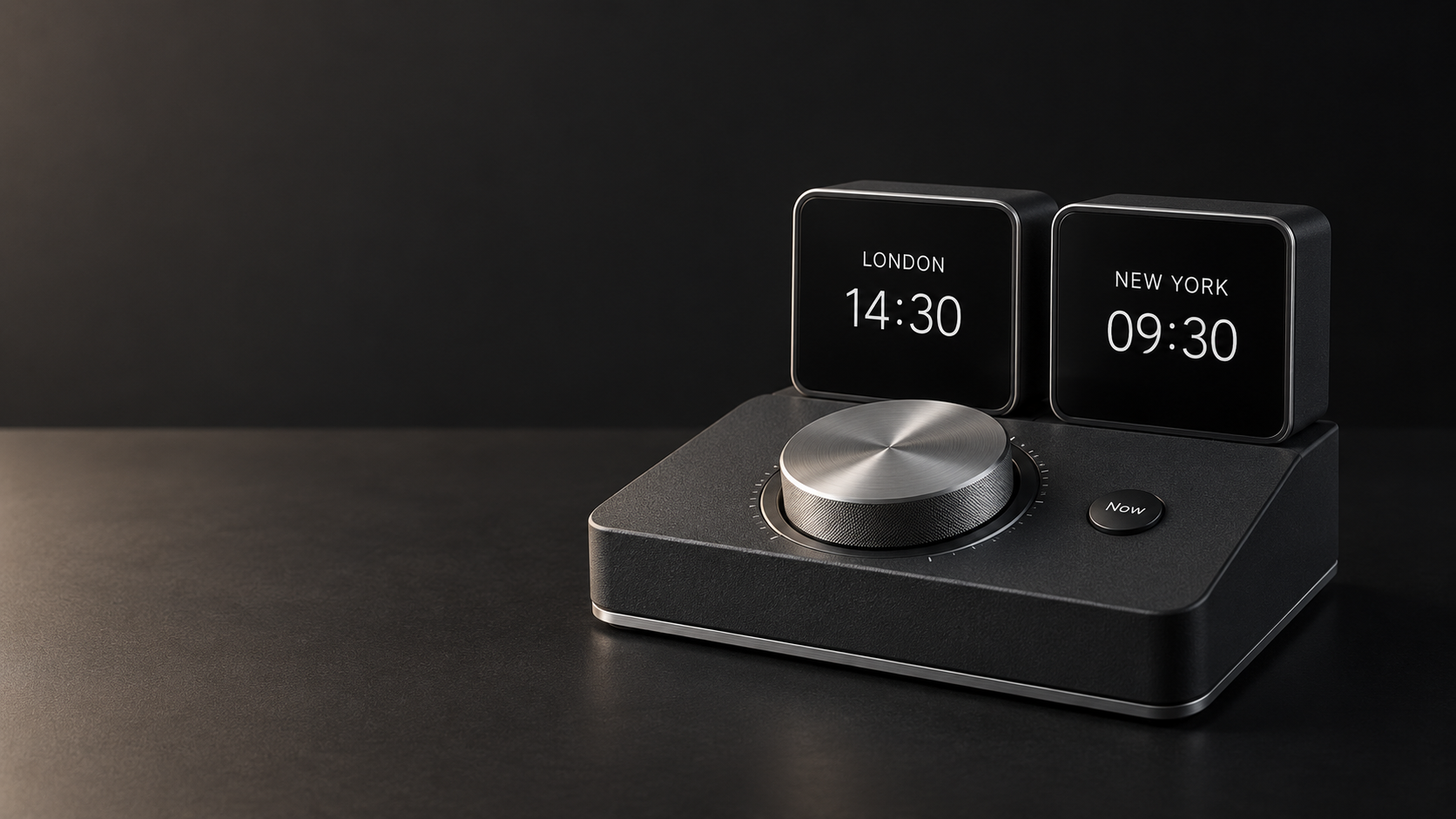
A screen, a simple stand and the TimeSlider interface. Move through the day with your finger, then tap Now.
HOWARD DONDRELL · POWERED BY TIMESLIDER
A desk instrument for lives across time zones. We’re exploring tactile ways to move through a shared moment. These are early concepts; no physical device has been built.
SAME MOMENT. DIFFERENT WORLDS.
A parent a few time zones away. A friend on the other side of the world. The team you make things with. We’re exploring a physical way to keep their time close—with a control you’ll want to reach for.
START WITH A SCREEN YOU ALREADY OWN
Put a spare phone on your desk, or give TimeSlider a small part of your tablet beside your stream notes. Try the app before choosing a physical clock.
Try the phone & tablet setupsTHE DESIGN COLLECTION / 01—06
Digital, mechanical, modular and maker directions. Explore the concepts and tell us which is worth investigating.
All six images are concept renders. There are no working hardware prototypes, and none of these designs is available to order.
A deliberate turn. Everyone’s time moves together. A planted base and a generous dial lead the tactile exploration.
A day you can move through with your fingertips. The familiar TimeSlider gesture, brought off the screen.
The quiet familiarity of a clock face, reimagined for more than one place. Real hands, with coordinated movement to explore.
Time with a little theater. A study in physical digits, visible movement and the character of a changing display.
Leave the workings in view. A playful direction for people who enjoy building something as much as using it.
A place for each person. Separate clock tiles that can grow with your world, with one shared time control.
Tile counts and layouts are illustrations. Any future modular design would need testing to establish its practical limit.
THE SOFTWARE BEHIND THE IDEA
This live TimeSlider demo lets you move clock displays through the day. Its on-screen slider is centered at zero, and Now returns the software to current time. A physical control has not been connected or tested.
TimeSlider is in development, with an interactive software demo. Hardware compatibility and software bundling will be defined before a paid launch.
Drag to explore. Now always returns to the current time.
THREE INTERACTION IDEAS
THE FEEL COMES FIRST
We’re comparing weighted bases and replaceable feet so the control stays where your hand expects it.
Metal knobs, supported shafts and controlled resistance. We’ll choose the mechanism by touch, then test it for repeatability.
Printed bodies let us refine the shape without committing to molds. Metal touch surfaces bring the premium feel where it matters.
A CAREFUL PATH TO A REAL PRODUCT
We plan to begin with a tactile USB dial and a weighted 3D-printed body. The computer runs TimeSlider and displays the clocks; the dial would be an accessory.
No hardware has been built. Price, specifications and timing are open, and the waitlist is free.
First, learn no date set
Compare a smooth turn, weight and everyday durability.
If it works price unknown
Try a limited batch only after the design and actual costs are understood.
Later no offer announced
Explore screen tiles and the other concepts after the first interaction is proven.
The stages are a plan, not a delivery schedule. No preorders or deposits will be taken through this waitlist.
A NEW HARDWARE IDENTITY
Founder, TimeSlider · Semicolon-D LLC
Howard Dondrell brings my name to a new exploration of time, touch and the people we make room for. Powered by TimeSlider, created by Semicolon-D LLC.
A FREE, NO-OBLIGATION WAITLIST
Tell us which direction interests you. We’ll share meaningful development updates if the project moves forward.
Joining is free. It is not a reservation, preorder or promise that a product will be made. No payment details are requested.
A FEW THINGS TO KNOW
No. Howard Dondrell is at the concept stage. The free waitlist takes no money and does not reserve a product. There is no price or delivery date.
No. The six images are concept renders. No Howard Dondrell device, connected agent or hardware prototype has been built. Electronic parts, firmware, controls and physical performance have not been validated.
The current plan is to explore a simple USB dial with a weighted 3D-printed body. A computer would run TimeSlider and show the clocks. The dial-to-app connection is not built or tested; later work depends on results and demand.
TimeSlider is the software behind the clock interaction and is currently in development. You can try its interactive demo today. Software bundling and any plan requirement will be stated in a future hardware offer.
The live demo shows the software behavior. An endless dial could send relative turns while Now resets the app to current time without moving the dial. A centered slider would need to be moved back by hand. A motorized return is a premium idea for future study. None has been tested in hardware.
Not currently. No released, validated build files or supported parts kit are available. File availability and open-source licenses are undecided.
Modularity is a design idea. The number of clocks, connection, power and reliability limits depend on the design and have not been tested.
There are no paid sales yet, so shipping, returns, warranty and support terms have not been established. Those terms would be published before any future sale.
TimeSlider has local MCP tools for reading times and managing desktop clocks with an optional app connection. A future connected Howard Dondrell device could display those same clocks. Device pairing and physical controls still need to be built and tested.